Free Reservation System for Kenyan Guesthouses and Lodges
One calendar for every booking: Booking.com, Airbnb, Expedia, safari agents, WhatsApp, phone calls and walk-ins. No double bookings. No missed reservations. Check-in, room status, a bill in KES, and daily reports. Free. No subscription, no trial period.
OnlineHotelier PMS is a free hotel reservation system for Kenyan guesthouses, B&Bs, beach cottages, tented camps and small safari lodges. It puts every booking in one calendar: Booking.com, Airbnb, Expedia, safari agent bookings, WhatsApp, phone and walk-in. Check-in, room status, housekeeping, itemised bills in KES, and daily reports are all included at no cost. The optional paid add-on is the channel manager, which syncs availability across OTAs automatically.
OnlineHotelier PMS at a glance
| Product | OnlineHotelier PMS, a free cloud hotel reservation and management system |
|---|---|
| Price | Free. No subscription, no trial period |
| Who it is for | Guesthouses, B&Bs, beach cottages, tented camps and small safari lodges in Kenya with limited inventory |
| Local tax handling | Set your service charge and VAT rate (where it applies to you) once in the settings. The bill calculates automatically in KES |
| Paid add-on | Channel manager that syncs availability and rates to Booking.com, Airbnb, Expedia and other OTAs. Pricing on WhatsApp |
| Runs on | Any web browser on a phone, tablet or laptop. Needs internet (mobile data works). Nothing to install |
| How to start | Sign up online, or message us on WhatsApp for guided setup |
One calendar for every booking source
You run a six-room guesthouse near Naivasha. A Booking.com reservation arrives for Cottage 2 on Saturday night. Then a WhatsApp message comes in from a safari agent: she wants the same cottage for the same night, two guests, full board.
You check your notebook. You check your phone. You are not sure which booking came first. A mistake here means an angry guest and a bad review.
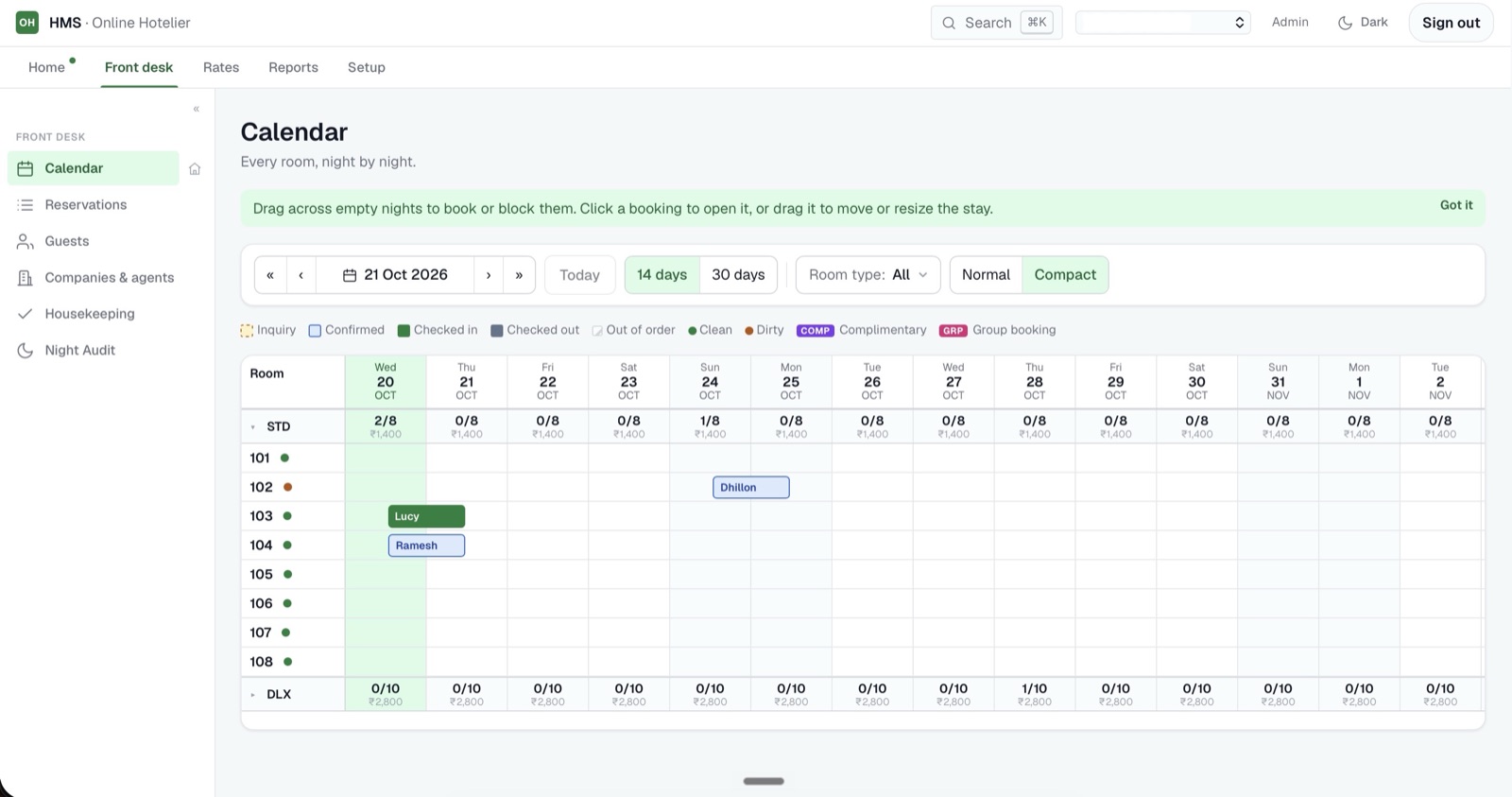
That is the problem the OnlineHotelier calendar solves. Every booking lives in one place, whatever its source:
- Booking.com, Airbnb and Expedia (via the channel manager add-on, or entered manually)
- Safari agent and tour operator bookings (entered at the front desk)
- WhatsApp messages and phone calls (entered directly)
- Walk-ins and direct bookings from your own site or social media
When a room is taken, the calendar shows it as blocked. No double booking. Nothing missed. If you add the channel manager add-on, a Booking.com reservation closes the room on Airbnb and Expedia automatically.
How bookings reach small Kenyan properties: Most guesthouses and small lodges in Kenya take a high share of bookings through WhatsApp and phone. Safari tour operators and travel agents send bookings by message or email. Booking.com and Airbnb handle the international segment. Keeping all these sources in one calendar is what removes the risk of double bookings.
Check-in, room status, housekeeping and check-out
The calendar is one piece. The rest of your day-to-day runs here too.
Guest check-in
Record the guest's name, passport or national ID number, nationality, and room on arrival. The system creates a guest folio (a running bill) from the moment they check in. Read our guide on the hotel check-in process for what to collect and why.
Room status
Mark rooms as occupied, vacant, dirty or clean after housekeeping. Front desk sees the update live so they know which rooms are ready for the next guest.
Housekeeping
Your housekeeper updates room status from their phone as they clean. No radio calls, no walking to reception. The room shows as clean the moment it is ready.
Guest check-out and bill
Post room charges, any extras, and the guest's payments to their folio. Review the itemised bill, apply service charge and VAT where they apply to you, and print or share it at check-out. Done in one step.
Daily reports give you occupancy, average room rate and total revenue for the day. Your manager gets the numbers they need each morning without building them by hand.
VAT, service charge and billing in Kenya
The PMS can be configured for any country's taxes and charges. You set your property's rates once and every bill calculates correctly from there.
VAT on accommodation
VAT (Value Added Tax) in Kenya is charged at 16% on accommodation and most hotel services. The threshold for compulsory VAT registration is KES 5 million in taxable annual turnover. Many small guesthouses and cottages fall below that threshold and are not required to register or charge VAT. Where it applies to you, the PMS applies the rate you configure to every bill automatically.
Service charge
Service charge is your own charge, not a government tax. Larger hotels in Kenya typically set it at 10% of the room rate. Many small guesthouses and cottages charge none. The PMS works either way: set it to 10% or leave it at zero. VAT (where it applies) is calculated on the room rate plus the service charge combined.
Here is how a typical bill looks for a property that charges service charge and VAT:
| Room rate (1 night) | KSh 6,000 |
| Service charge (10%) | KSh 600 |
| Subtotal | KSh 6,600 |
| VAT (16% on KSh 6,600) | KSh 1,056 |
| Total payable | KSh 7,656 |
The PMS calculates this automatically. You set the service charge percentage and VAT rate once in the settings. Every bill comes out right.
Tourism levy: Licensed tourism establishments pay a 2% levy on gross sales to the Tourism Fund under the Tourism Act 2011. Whether this applies to your property depends on your registration with the Tourism Regulatory Authority. Ask your accountant or the TRA whether you need to collect and remit it. The PMS produces an itemised bill; any levies are managed separately in your accounting.
eTIMS
KRA's eTIMS (Electronic Tax Invoice Management System) now covers most businesses in Kenya, including non-VAT-registered ones. The PMS produces an itemised bill for every guest. eTIMS invoicing is done through KRA's own eTIMS tools, not through the PMS. Ask us on WhatsApp if you want guidance on how to use the two systems together.
Payments
Record how each guest paid. The PMS supports:
- M-Pesa (Paybill, Till or Send Money): enter the transaction code you receive and the PMS records it
- Airtel Money: same process, enter the reference code
- Card payment
- Bank transfer
- Cash
You still confirm each M-Pesa payment in your own M-Pesa account. The folio keeps a full payment history. Your daily report shows total collections by payment type.
Guest records
Licensed tourism businesses in Kenya are required to keep guest records under the Tourism Enterprises Regulations 2025. The PMS stores each guest's name, nationality and ID details as you enter them at check-in. Those records stay in the system for as long as you need them.
Property types across Kenya
The system is built for small properties. Wherever you are in Kenya, if your main job is keeping track of who is in which room on which night, this covers it.
Nairobi and Naivasha guesthouses
Urban guesthouses and B&Bs serving business travellers and weekend getaways. A steady stream of Booking.com reservations mixed with direct calls and WhatsApp bookings from repeat guests.
Masai Mara tented camps and lodges
Small tented camps and budget lodges near the Mara. Most bookings arrive through tour operators and travel agents, with Booking.com covering the self-drive and international segment. The calendar keeps agent bookings and OTA reservations in one place.
Diani, Watamu and Lamu beach cottages
Beach properties on the Kenyan coast. Airbnb and Booking.com bring international guests. Local agents and WhatsApp fill the gaps. Seasonal peaks mean double booking risk is highest when you most need a clean system.
Amboseli and Tsavo lodges
Small properties near the parks, often a mix of Booking.com, tour operator block bookings and direct calls. The calendar handles all three sources in one view.
Airbnb-style units
A house, an apartment or a few self-catering cottages listed on Airbnb. The PMS gives you a proper system beyond the Airbnb app: a calendar that also captures direct bookings, a guest record, and a proper bill.
B&Bs and homestays
A family home with two or three rooms and no front desk system. A free tool that runs on a phone and takes a few minutes to sign up for is a big step up from a notebook and a WhatsApp group.
Channel manager: for when you outgrow updating each OTA by hand
If you are on one or two OTAs and you update availability yourself after each booking, the free PMS is enough. Most small properties start here.
The channel manager add-on becomes useful when you are on three or more OTAs and a booking on one platform means you need to close the room on all the others. Doing that by hand is slow, and a missed update causes a double booking.
The add-on connects your PMS calendar directly to Booking.com, Airbnb, Expedia and other OTAs. When a booking arrives, all connected channels update automatically. Read our guide on what a channel manager does before deciding whether you need one.
The channel manager add-on is paid. Message us on WhatsApp and we will give you the current price for your property.